
Shock of content.
Mark Schaefer predicted for the first time five years ago, in 2014.

The marketing department should have taken this as a warning, and some of us did.
But not enough.
Instead of walking together (and our audience) with content, We continue to run a metaphorical race to see who can publish the most content with the highest word count.
Therefore, the content shock continued to worsen, both for marketers and for the audience for whom we create content.
Now, we're really involved and we need to start dealing with the consequences.
“"It's" being overwhelmed with content, and wow, it's hard to navigate.
Have you ever…
- Have you experienced creative burnout or writer's block?
- Have you experienced regular burnout?
- Have you started to feel repetitive with your content?
This is all thanks to the content overload, marketing saturation, and the "more is better" approach to content that the content marketing industry has been adopting over the last decade.
If you've dealt with any of the items on the list above, you may already be adopting a more sustainable approach to your content strategy.
But if you're still not convinced that more content It's not better, allow me to convince you.
Here are six reasons why more content isn't better – and can, in fact, be worse.
1. Content marketers are not immune to the burnout epidemic.
We are in the midst of a reckoning with Hustle Culture, a work culture that glorifies endless productivity, overwork, and sacrifice more than health, balance, and boundaries.
In 2019, we began to see the beginning of the end of that mentality.
First, there was the article. BuzzFeed viral post about millennial burnout. .Not that burnout is exclusive to the millennial generation.
So, at the end of the year, the World Health Organization officially added Workplace stress is classified according to the International Classification of Diseases.
And throughout the year, we started to see more discussions about burnout that were frankly behind schedule .

Merchants of all kinds – from in-house , for -side agency , for self employed They are joining the discussion.
In fact, Search Engine Journal also joined the conversation, introducing a weekly self-care column where, along with other marketing professionals, we discussed my own experience with burnout.
This is clearly something we're dealing with, and it's time we learned how to adapt content marketing practices born in Hustle Culture to suit the next era of balance.
2. All strategies have a point of diminishing returns.
The second reason to start adopting a "less is more" approach to content marketing is the economic principle of the Law of Diminishing Returns.
According to Investopedia , Here's what that means:
“"The law of diminishing marginal returns states that, at some point, adding an additional factor of production results in smaller increases in output.".
So, what does this mean for marketing? content?
Well, there's a limit to the impact you can have with a given content strategy, regardless of how often you implement it by publishing new content.

There are so many people you can reach simply by increasing the amount of content without addressing other more important aspects of your strategy, such as:
- Content quality.
- Segmentation of the customer journey.
- Lead nutrition.
- Conversion.
At some point, you will have created all the necessary content and will spend more time marketing that content than creating more.

3. Unnecessary content generates bad leads.
At some point, you will have created "enough" content.
You will have covered all your bases. You have created content on all the key touchpoints and talking points in customer journey .
Google Ads' free report finds improvements in 60 seconds.
Based on real data from their own campaigns.
At this point, you will have the option to continue talking more about the same things or to dedicate yourself to related topics.
Most people branch out.
For example, if you're a marketing software tool, you could start by talking about sales. If you target photographers, you could start expanding to talk about video.
Sometimes it works, but often it doesn't.
Because, depending on your strategy for converting viewers into customers, this can end up filling your funnel with bad leads who don't need your product or service.
Therefore, while slightly off-topic content might inflate traffic numbers and other top-of-funnel marketing metrics, it can dilute your brand's value proposition, attract irrelevant audiences, and harm the bottom-of-funnel metrics that truly matter.
4. Repetitive content creates a confusing experience.
In the section above, I described one way to deal with the "we've already covered everything that's important" issue. Another way is to create more content on the same topics.
But marketers rarely do this in a user-friendly way.
For example, let's look at an example from my own past mistakes. When I worked at a company that targeted content marketing professionals, I wrote three or four different pieces on content brainstorming.
This made it difficult to promote and reference these pieces to our audience without confusing them. It was even difficult to keep the pieces organized.
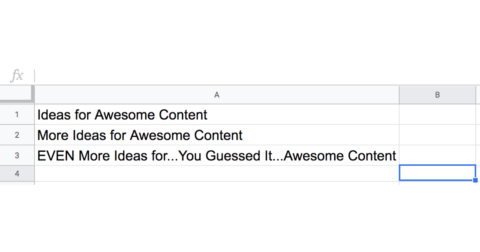
Instead, I could have continued to update, expand, and improve one section over time with all the new information for which I was creating separate posts.
5. The published content requires maintenance.
Permanent content he must to be updated.
Yes, evergreen content can continue to generate traffic, leads, and sales for years, but only with maintenance.
If you're visualizing content as plants, your content library will be a garden.
And with gardening, you can't just plant seeds and leave them alone.
Individual pieces of content require maintenance over time to transform into powerful, enduring pieces of content.
This can include things like:
- Continuing to update the content with timely information.
- Re-optimizing content around different focus keywords.
- Updating your product's call-to-action phrases and links.
- Adding new images and links.
- Re-promote your old content so that it can be seen by your new audience.
Continuing to produce new content without maintaining what you already have is essentially a strategy of agitation and burning.
The more content you have, the more maintenance your content marketing will require, and you'll need time (and space in your marketing calendar) to take care of it.
6. It frees you to promote what you have.
Finally, the best reason to focus on less (but better) content is that it frees you up for other areas of marketing.
Let's be realistic, a marketer's to-do list is never-ending. There's always more to do, and much more than just creating content.
By creating less content, you and the rest of your marketing team have more time and energy to focus on other parts of your marketing strategy using the content you already have.
For example, you can finally start following this rule to spend so much time promoting its content as well as creating it.
There is more time for promote the content on social media, optimize it for SEO, create backlinks, redirect it for other formats and everything else that gets pushed to the bottom of your to-do list.
Focus on less, but better.
There's a popular saying in the minimalist movement and community: "more isn't better, better is better.".
It's an approach that more of us need to adopt with our marketing.
We only have so much time to dedicate to our content marketing, so let's ensure that the content we publish is worthwhile, rather than overwhelming our readers and ourselves by contributing to content shock.
Image credits
Featured image: Unsplash
Content shock graph: Mark Schaefer
Burnout chart: Statista
All other images created by the author, February 2020.